While Expository preaching is crucial in teaching the Word of God, it is equally important to be an expository listener. This blog has been set up for those who have enjoyed listening to the sermons preached at Grace and Truth Church and want to go deeper in their learning and encouraging of others.

Saturday, December 25, 2010

What Were the Angels Singing?

Tonight as I was putting my daughter to bed, we read the nativity account from her Jesus Story Book Bible and left off on the account of the shepherds who had a vision of the angelic host of heaven singing on that first Christmas night. After we read the account I sang "Hark the Herald Angels Sing" to her and put her to bed. Every Christmas when I hear that song, it invokes memories of George Bailey holding his baby daughter in his arms and hearing a bell ring, signaling that Clarence the angel has obtained his wings.  Although I love "It's a Wonderful Life" and enjoy the wholesome message of a classic movie, I think many people overlook the classic Christmas carol and the rich theology behind it. When Charles Wesley wrote this song he was thinking of the glorious event of Christmas when God became a man. His words were as theologically sound as can be, "Veiled in flesh the Godhead see; Hail th’incarnate Deity, Pleased with us in flesh to dwell, Jesus our Emmanuel." Wesley the evangelist was preaching the gospel even in his music.

But why is Christmas so important? Why do we celebrate this holiday every year? Why do we sing carols like this? Because the night Jesus was born, the single most spectacular and historical event that would even happen- took place. The same God who created the universe and placed all the stars in their place, and who created the earth and all that exists, and who had been making promises to mankind through the descendants of Abraham for generations, had come down to earth and was born to a woman as a human baby boy. The night Jesus was born the unimaginable took place...A Holy, Omnipotent, Omniscient, and Omni-present God, humbled himself to become like the very people he created... in His image. The concept is so amazing, and so tremendous, that for generations people have denied the incarnation of Christ, from the religious( like the Watchtower Organization), to the intellectual, and scientific community who disregard it as a myth of the old world. But to us who believe, it is no fable, and it is no theological paradox- it is the greatest truth that we hold dear to our hearts- that God loved us so much he gave us his only Son as a gift, to die for our sins, that all who believe in him, would have hope of being forgiven our sins, and living forever with him in all eternity. This is the greatest gift anyone can receive! It is the gift of God, His Son. And as scripture says, "He who did not spare his own Son but gave him up for us all, how will he not also with him graciously give us all things?" Rom. 8:32. Essentially Christmas is about God giving us everything. You may not have gotten an I-pad this Christmas, or that vacation to Hawaii, but in reality- you have much more if you have Christ.

So what were the angels singing? Luke 2:14 answers the question, "“Glory to God in the highest, and on earth peace among those with whom he is pleased!”

What more can we sing or say on such an occasion, but "Glory to God in the highest."? In no other way is God glorified more than in the reconciliation of his elect back to himself though  the work of His son, who destroyed the works of the devil. And what more can the angels sing but, "Peace to those on earth" That is because when Jesus was born, he was the very one who would make peace, between God and man by becoming our peace offering and bearing our sins on the cross reconciling us back to God. And only through faith in Jesus Christ can there ever be true peace on earth between fellow human beings. Through Jesus, the walls of hostility have been broken down and in Christ there is no east or west, or Jew or Gentile, but all are ONE in Him. There was great reason to sing at the first advent of Christ and great reason to rejoice. And we still have great reason to rejoice.

I pray that the Lord would bless you all this Christmas and that you may truly enjoy this holiday for what its really means and not for the word has turned it into. May God grant us all the grace to behold his wondrous and glorious ways, in comprehending the mystery of the incarnation, and all the implications of that great expression of divine love.

Monday, December 13, 2010

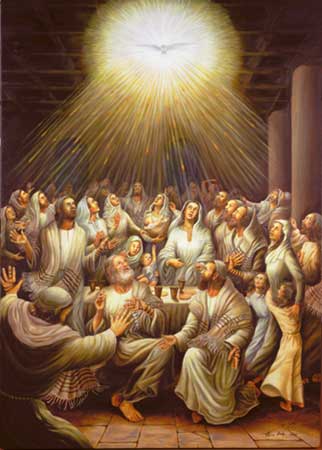
Apostolic View of Pentecost

Yesterday I preached one of the most difficult sermons I have ever had to preach. Not so much because the text and subject was hard for me to understand, but because of the sensitivity of the subject for so many believers. One of the main things that was important to me in yesterday's sermon was the importance of understanding the Baptism of the Holy Spirit.  What was even more important was to see not my interpretation, but to see the apostolic interpretation. Both at Pentecost and at the home of Cornelius, the Apostle Peter gives an apostolic interpretation of the meaning of the Baptism in the Spirit, and the following occurrence of glossolalia.

1n Acts 2 Peter clearly give the meaning of the event: Acts 2:14-17 “Men of Judea and all who dwell in Jerusalem, let this be known to you, and give ear to my words. 15 For these people are not drunk, as you suppose, since it is only the third hour of the day. 16 But this is what was uttered through the prophet Joel:“‘And in the last days it shall be, God declares, that I will pour out my Spirit on all flesh.."

The significance of Pentecost was that ALL of God's people would receive the Holy Spirit for empowerment of ministry, and the speaking of tongues was visible and dramatic demonstration of this truth, in that different dialects of different people were being heard. This meant that ALL people meant ALL "nations, tribes and tongues". 

In Samaria, when the Gospel was following the path that Jesus had ordained, there was another Pentecostal experience,  again to confirm the inclusion of Samaritans into the Covenant community, and again Peter is sent in to affirm that the Samaritans as well were to be accepted as members of God's covenant community. 

Acts 8:14-17  Now when the apostles at Jerusalem heard that Samaria had received the word of God, they sent to them Peter and John, 15 who came down and prayed for them that they might receive the Holy Spirit, 16 for he had not yet fallen on any of them, but they had only been baptized in the name of the Lord Jesus. 17 Then they laid their hands on them and they received the Holy Spirit. 

After Peter had preached to Cornelius and his home and saw them baptized in the Spirt as well,  he reported back to Jerusalem this amazing event, and again interpreted again the meaning. 

Acts 11:15- 18 As I began to speak, the Holy Spirit fell on them just as on us at the beginning. 16 And I remembered the word of the Lord, how he said, ‘John baptized with water, but you will be baptized with the Holy Spirit.’ 17 If then God gave the same gift to them as he gave to us when we believed in the Lord Jesus Christ, who was I that I could stand in God's way?” 18 When they heard these things they fell silent. And they glorified God, saying, “Then to the Gentiles also God has granted repentance that leads to life.”

This was truly amazing! That the Lord gave his Spirit to the Gentiles just like he did the Jews indicating that they were to be included and accepted by the Jewish believers as co-heirs in the gospel! This may not sound like a big deal now, but had tremendous significance at this point in redemption history.

Today we are far past the age where God needs to demonstrate to us visibly who is included and accepted in the Kingdom of God. We are living in a post -Pentecostal time, where ALL believers, no matter their background are baptized in the Holy Spirit at the moment of conversion.

As the scripture teaches us, "For in one Spirit we were all baptized into one body—Jews or Greeks, slaves or free—and all were made to drink of one Spirit." 1 Cor. 12:13

It is important that we read the bible in its context and let it interpret itself. When we try to interpret the bible based on our own experiences than we are leaning in a direction of subjective hermeneutics that can be very dangerous.

Tuesday, December 7, 2010

Prophecy

This week, we looked at the gift of prophecy and examined the different approaches to understanding this gift, defining it and asking our selves if this gift indeed is still in operation. My own position leans towards the Wayne Grudem view that prophecy still exists, but is not authoritative or revelatory. God can use it to encourage and exhort his people and it is a gift that bears witness to the Holy Spirit's dwelling in the church. Sadly because of so much abuse and "false prophecy" that has existed in the church, many have disregarded the authenticity or operation of the gift any longer. Sadly we take reactionary positions as a result. This week- I want to open it up to you. What do you think? Are you a cessationist? Are you a continuationist? Or are you a Charismatic? What has your experience taught you? Have you ever seen an authentic prophecy fulfilled? What about bad experiences with false prophecies? I am sure the answers are legion.

While I do believe the gift of prophecy is still in existence I am content to claim the truth of scripture:

Rev. 19:10 For the testimony of Jesus is the spirit of prophecy.

Monday, November 29, 2010

Should we Expect Miracles?


Yesterday we examined the gift of "working out of miracles" as one of the gifts listed in the "Gifts of the Spirit" in 1 Cor. 12:4-11. One of the things we established and made clear is that miracles are extraordinary and supernatural works of God, that were given as signs and wonders to validate the messengers of God. The only times in history where we see concentrations of miracles is in the ministry of agents of revelation: Moses, Elijah, Jesus, and the Apostles. Other than that miracles are not common or ordinary, but rather, unusual, and extraordinary. Based on that we concluded that when the bible was finished being written, miracles had ceased to occur for the reason that God's special revelation to us is complete. So why are so many people still seeking the miraculous? Because they are not satisfied with the Word of God. They are looking for something more, something tangible and something they can look for and hope in. In desperation people are willing to believe in anything, thus creating a market ripe for the picking. This is not theology 101, but business 101. The phony miracle workers have a lucrative business, because the market demands them. In fact I would argue there is more demand than supply, leaving a deficit in "miracle workers."

I am reminded of what scripture teaches, 2 Tim. 4:3-4 "For the time is coming when people will not endure sound teaching, but having itching ears they will accumulate for themselves teachers to suit their own passions, and will turn away from listening to the truth and wander off into myths."

This describes the demand side of the false miracle business. We are living in that time, where people who are not content with what God has already revealed are looking to believe in anything but the truth. So in a sense, it is the masses of ignorant and unstable people who create these men. But make no mistake about it, that does not excuse the false prophets. They are greedy and see the masses as walking dollar bills. They are evil and cunning and have used the Gospel for their selfish advantage, and exploited the poor and ignorant for their own good. Scripture has much to say about them as well.


2 Pet. 2:2,3 "many will follow their sensuality, and because of them the way of truth will be blasphemed. And in their greed they will exploit you with false words."

14-15 They have eyes full of adultery, insatiable for sin. They entice unsteady souls. They have hearts trained in greed. Accursed children! Forsaking the right way, they have gone astray. They have followed the way of Balaam, the son of Beor, who loved gain from wrongdoing, 

17-19 These are waterless springs and mists driven by a storm. For them the gloom of utter darkness has been reserved. For, speaking loud boasts of folly, they entice by sensual passions of the flesh those who are barely escaping from those who live in error. 19 They promise them freedom, but they themselves are slaves of corruption

One thing is for sure: God is just. These guys will all have to give an account one day for their lies, deception and stealing in the name of Jesus. They have received their reward now, but on Judgment Day, they have a special reservation for them- the gloom of utter darkness. May God have mercy on their souls.

Tuesday, November 23, 2010

Charismata

In my last two sermons in 1 Corinthians, I have started to examine what was going on in the Corinthian church in relation to the "charismata". The term "charismata", in the original Greek simply means, "grace gifts" and is used in modern Greek to say, "birthday gift". Some changes, but the intent is more or less the same...an undeserved, and unmerited gift from God. Now we know that God in his grace has given us many gifts. The gift of salvation (Eph. 2:8-9), justification (Rom. 5:16), Eternal life (Rom. 6:23) the gift of giving (2 Cor. 9:15) etc. But we are talking specifically here about the gifts of the Holy Spirit, which are given to the elect for the purpose of building up the church. Eph 4:7 "But grace was given to each one of us according to the measure of Christ's gift" It is the Holy Spirit who takes that which is Christ's and applies to us making it our own. Therefore, every person who is born again and is given the Holy Spirit has been gifted by the Spirit for some type of ministry, and there is no such thing as the gift of pew warming. When we think of Christians being charismatic, we automatically assume that they must be prophets, speak in tongues or perform miracles, but this is not the case. There are many gifts that the Holy Spirit has bestowed on His church which are not spectacular or supernatural. Thus, if we are to interpret Scripture correctly- all Christians are charismatics. The problem is how we interpret charismatic.We need to take closer look at the scriptures. In Corinth the gifts that were manifested and were emphasized by the Corinthians, Paul makes reference to in 1 Cor. 12:9-11. But that is not an exclusive or exhaustive list. For instance look at Rom. 12:6-8

Having gifts that differ according to the grace given to us, let us use them: if prophecy, in proportion to our faith;  if service, in our serving; the one who teaches, in his teaching;  the one who exhorts, in his exhortation; the one who contributes, in generosity; the one who leads, with zeal; the one who does acts of mercy, with cheerfulness.

Did you ever think that serving is a gift? What about the ability contribute to the the finances of the church? Or the what about showing mercy? These are gifts of the spirit as well! They may not be spectacular or illustrious, but for the most part being a Christan is living our day to day lives not on the mountain top experiences of the supernatural highs, but rather on the plateaus and valleys where we live by faith in Christ, and are enabled by the Spirit to minister in every day life.

Too often the charismatic church puts all their emphasis on the spectacular and the extraordinary. But that's not reality. The Christian walk is not a Harry Potter movie. The bible may have records of the miraculous and supernatural, but they do not characterize the majority of biblical history.  A thorough reading of the bible gives us examples of many believers who lived their life day to day in the power of the Spirit and yet these are the men and women have likewise been gifted by the Holy Spirit.

The challenge for all of us is to discover our gifts and put them to use. How do we do that? First we should pray and ask God to show us where he has gifted us to serve. Second- you should ask your pastor or an elder what they think. Often an elder, or pastor will have good insight into a persons gifting. But ultimately, God will confirm it to you as you live out your life and people will actually tell you what your gift is. The real point is that we are exercising our gifts. On judgment day we will all have to give an account for how we used the gifts God has given us. I personally think that the parable of the talents can have application here. To whatever level of gifting you have received is to the level we are responsible.

Luke 12:48 Everyone to whom much was given, of him much will be required, and from him to whom they entrusted much, they will demand the more.

Tuesday, November 2, 2010

A Righteousness Not Our Own

Not too long ago I was challenged by someone to rethink the imputation of Christ's righteousness to the sinner and consider that the teaching of the active obedience of Christ was simply a result of an antiquated argument. After pondering these ideas for some time it was obvious these were thinly veiled suggestions coming from the popular "New Perspective". For those of you who have no clue what I am talking about, don't feel bad. In the academic world of evangelicalism there are some heated debates among Christian scholars that the average lay person would have no clue about. However those academic debates eventually trickle down to the lay persons in one form or another. The debate we are talking about is with New Testament scholar and Anglican Bishop N.T. Wright.  Bishop Wright is a brilliant man and among one of the best New Testament scholars in the church, and has contributed a great deal of good to the church. However he has also reintroduced a teaching that is not sound and can lead to serious problems if left unchallenged.  The teaching commonly refereed to as the "New Perspective of Paul" based on his book- "Paul in Fresh Perspective". Overall Wright argues that evangelicals have misunderstood justification as it was understood by Paul. One of his arguments, among many, is that imputation was merely a product of middle age thought and restricted to just the Reformation mind set. Based on new scholarship of Judaism during the first century, he argues that we now have a "fresh perspective" so to speak, on Paul's view of justification. Here a couple of snippets of his views:


It is therefore a straightforward category mistake, however venerable within some Reformed traditions including part of my own, to suppose that Jesus ‘obeyed the law’ and so obtained ‘righteousness’ which could be reckoned to those who believe in him. …It is not the ‘righteousness’ of Jesus Christ which is ‘reckoned’ to the believer. It is his death and resurrection.”
N.T. Wright, Justification: God’s Plan and Paul’s Vision, p. 232

Is there then no 'reckoning of righteousness' in, for instance, Romans 5:14-21? Yes, there is; but my case is that this is not God's own righteousness, or Christ's own righteousness, that is reckoned to God's redeemed people, but rather the fresh status of 'covenant member', and/or 'justified sinner', which is accredited to those who are in Christ, who have heard the gospel and responded with 'the obedience of faith'." -N.T. Wright, 10th Edinburgh Dogmatics Conference: 25–28 August 2003, p. 8

In the this weeks sermon I made a clear biblical case for the doctrine of imputation and believe it is as clear as can be. I adamantly reject the New Perspective on the grounds that it leaves many questions unanswered about righteousness, and leaves the door wide open for works righteousness, whereby the believer is credited with a righteousness of their own. I cannot see how it is possible for a believer to merit any good before God. But for anyone who  may doubt, I will not pretend to be a scholar, and instead point you to some of the most formidable theologians and scholars of our day and allow them to dissect Wright's views. Below are a few links that you will find helpful. But a more thorough search will help you find a wealth of resources.

Tom Schreiner's article

More Media from Ligonier Ministries

Media by D.A. Carson

Media by John Piper 


Happy Studying!

Monday, October 25, 2010

The Proper Observance of the Lord's Supper

What a wonderful occasion the Lord's Supper is for believers to celebrate and remember the work of Christ on the cross. If there is one thing we learned yesterday is that one of the key aspects of the Lord's Supper- is that it is a time to remember. Memorials are important in our life so we never forget life changing and important events in our life and society. As a nation we celebrate the 4th of July as Independence Day, remembering what it took to gain independence as a nation. On Sept. 11 of every year, we take time to remember the tragic loss of lives on 911 when so many people died in the worst attack on our nation. The names are read from Ground Zero every year as a memorial so that the reality of what took place there may remain fresh in people's memory. As married couples we celebrate our wedding anniversary every year usually by going to a special dinner and play, or maybe a vacation  to spend time as a couple reflecting on the genesis of love in one's relationship. In the same way the Lord instituted the Lord's Supper so that the message of the gospel would remain fresh in our minds on a frequent basis. The Lord's Supper brings us back to Calvary and back to where the greatest act of God for mankind ever took place. It was monumental and was a life changing event for all who believe. The Lord's Supper brings us back to the foot of the cross, to see how our sins hung our Lord on that cross to be our vicarious substitute in atoning for our sins. When you begin to consider the importance of the meaning behind the Lord' Supper, we begin to value it as more than just a ritual but a celebration of eternal life.

In a recent article written by CJ Mahaney he writes this, "It is frighteningly easy to lose sight of Calvary. We drift away from the cross, not toward it." What CJ writes demonstrates that our natural tendency is to drift from the cross. What an amazing display of God's grace and wisdom to institute the Lord's Supper to keep the cross fresh in our minds! May we always live our lives close to the cross, and never let go. May we live in the grace of God knowing our sins have been forgiven and humbled by the great price paid for our redemption. Hallelujah! What a Savior!